

Florida is experiencing its largest locally acquired dengue outbreak in nearly one-hundred years, with the vast majority (about 95%) concentrated in the Tampa Bay area—primarily Hillsborough County. When can Florida, including Tampa Bay, anticipate an end to this? A typical mosquito season would end in six days, but is by no means a typical mosquito season!
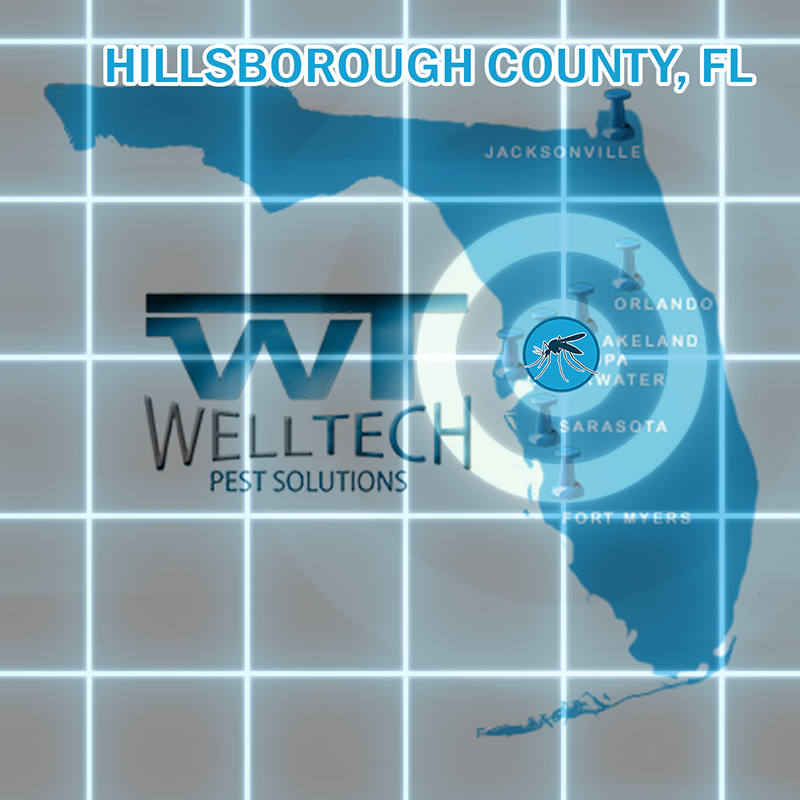
Current numbers of Dengue Fever with less than one week of a typical mosquito season
1. Week-by-Week Summary of Locally Acquired Dengue Cases (2026)
Florida’s local transmission of dengue fever, primarily driven by the Aedes aegypti mosquito, began accumulating reported onsets mid-summer, picking up sharp momentum through late August and September. The Florida Department of Health (FDOH) tracks locally acquired cases based on the date of symptom onset as well as the week laboratory confirmation is formally published.
- Early Summer (May – June): Baseline activity; travel-associated cases dominated reports, while locally acquired cases remained at low background levels (0–2 cases per week statewide).
- July (Weeks 27–30): First sustained local transmission detected in West-Central Florida, totaling approximately 21 locally acquired cases across the month.
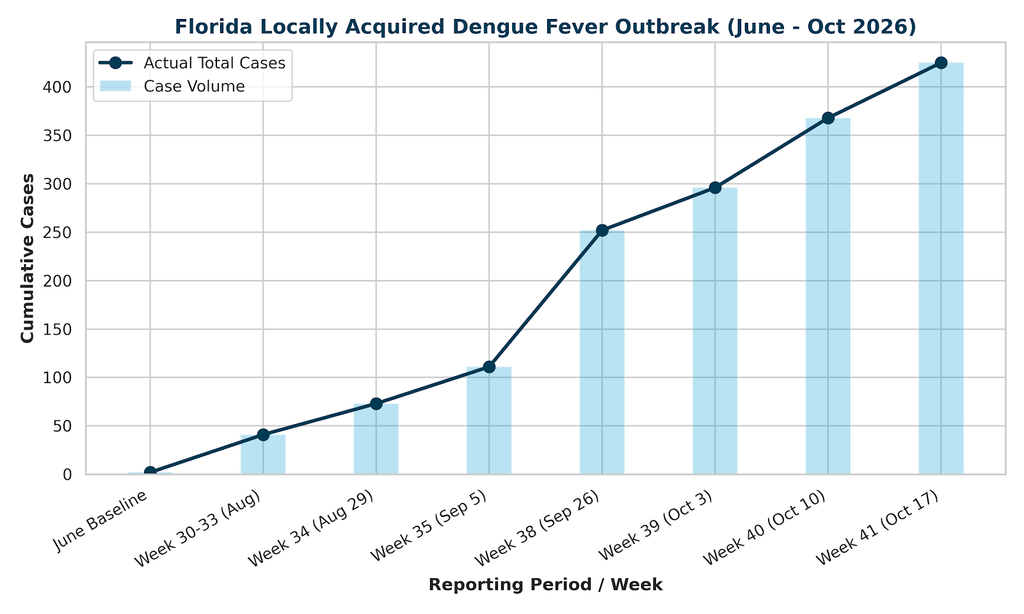
- August (Weeks 31–35): Mosquito activity surged following mid-summer heat and rain. Cases steadily accelerated, accumulating 159 locally acquired cases statewide by the end of the month.
- September (Weeks 36–39): Peak transmission period.
- Mid-September (Week 38 report): Total locally acquired cases reached 190 cases across 6 counties (Hillsborough declaring a local emergency).
- Late September (Week 39 report): Cumulative total rose past 252 local cases as Polk became the 7th county to report local spread.
- October (Weeks 40–42):
- Early October (Week 40 report): FDOH reported a sharp single-week jump of 72 newly confirmed local cases, bringing the statewide total to 368 cases.
- Mid-to-Late October (Weeks 41–42 reports): Statewide totals expanded past 425 locally acquired cases.
County Breakdown Highlights:
- Hillsborough County: Serves as the epicenter of the 2026 outbreak, accounting for over 80% of all state cases (310+ local cases).
- Pinellas County: Second-most impacted area, jumping sharply to 37+ cases by mid-October.
- Other Affected Counties: Miami-Dade, Orange, Pasco, Seminole, Broward, Palm Beach, and Polk counties.
2. Florida Department of Health Warnings & Advisories in 2026
In 2026, the FDOH issued at least 8 distinct county-level Mosquito-Borne Illness Advisories and Alerts directly tied to locally acquired dengue activity:
- Hillsborough County: Issued a Mosquito-Borne Illness Advisory, later upgraded to a Mosquito-Borne Illness Alert / Local Health Emergency as community transmission accelerated.
- Orange County: Issued a Mosquito-Borne Illness Advisory, updated to an active Alert in October following localized cases.
- Pinellas County: Issued a Mosquito-Borne Illness Advisory following rapid case growth.
- Pasco County: Issued a Mosquito-Borne Illness Advisory.
- Polk County: Issued a Mosquito-Borne Illness Advisory upon confirming its first local case.
- Seminole County: Issued its first Mosquito-Borne Illness Advisory of 2026 in mid-October following a confirmed local case.
- Miami-Dade County: Maintained ongoing Mosquito-Borne Illness Advisories throughout the summer due to recurring local and travel-associated cases.
3. How and When the Mosquito Season Could End
While northern states experience a sharp cutoff in mosquito populations after the first hard freeze, Florida’s mosquito season transitions differently due to its subtropical climate.
When Does the Peak Season End?
The peak rainy-season surge (May through October) typically draws to a close during the last week of October and early November.
- With less than one week remaining in Florida’s typical high-risk rainy season (which officially winds down around late October), vector pressure begins to subside.
- However, in South and Central Florida, mosquitoes do not die off entirely; activity shifts from high-density breeding to a lower winter baseline.
Environmental Factors Required to End Transmission:
- Drop in Ambient Temperatures below 50°F–55°F:
- Aedes aegypti mosquitoes become lethargic below 55°F and cease feeding/reproducing when temperatures drop below 50°F. Sustained cold fronts in late autumn slow down the extrinsic incubation period (the time it takes for the virus to replicate inside the mosquito).
- Transition to the Dry Season (Humidity & Rainfall Reduction):
- Florida’s dry season begins in November, dramatically reducing standing water in gutters, saucers, and yard debris. Without fresh rainwater pools, female mosquitoes lose key oviposition (egg-laying) sites.
- Shorter Daylight Hours:
- Decreasing day length in November triggers natural dormancy/reduced flight activity in adult mosquito populations.
Evaluation of the Predictability Index (35% to 50% Weekly Increase)
The predictability index projecting a 35% to 50% weekly increase in locally acquired dengue cases was partially correct during the explosive expansion phase (late August through early September), but ultimately incorrect (overestimating growth) as the outbreak matured into October.
- Where it was correct: During the rapid acceleration phase (e.g., Week 34 to Week 35), weekly new cases surged by 52.1%, aligning closely with the upper bound of the model.
- Where it proved incorrect: Following the week 34 to Week 35, there was an over 100 percent increase during Week As enhanced vector control measures, local states of emergency, and shifting environmental factors took effect in October, actual weekly growth rates compressed to 15.5% – 24.3% (well below the 35% threshold), demonstrating that community mitigation successfully blunted exponential trajectory.
WellTech Pest Solutions Continues Providing FREE mosquito inspections
WellTech Pest Solutions President Jay Wells made a commitment to provide free mosquito inspections to property owners in September, and would continue to do so upon the end of the 2026 Dengue Fever outbreak, or the end of the mosquito season. Based upon current estimates, this program will continue into November, and not end October 31st. There is still time to get the inspection, and if your property needs educational materials for next year in case this trend continues or any other mosquito-borne illnesses, reach out to your account manager or the marketing department.