
A Property Manager’s Guide to the Dengue Fever and the rest of mosquito season.
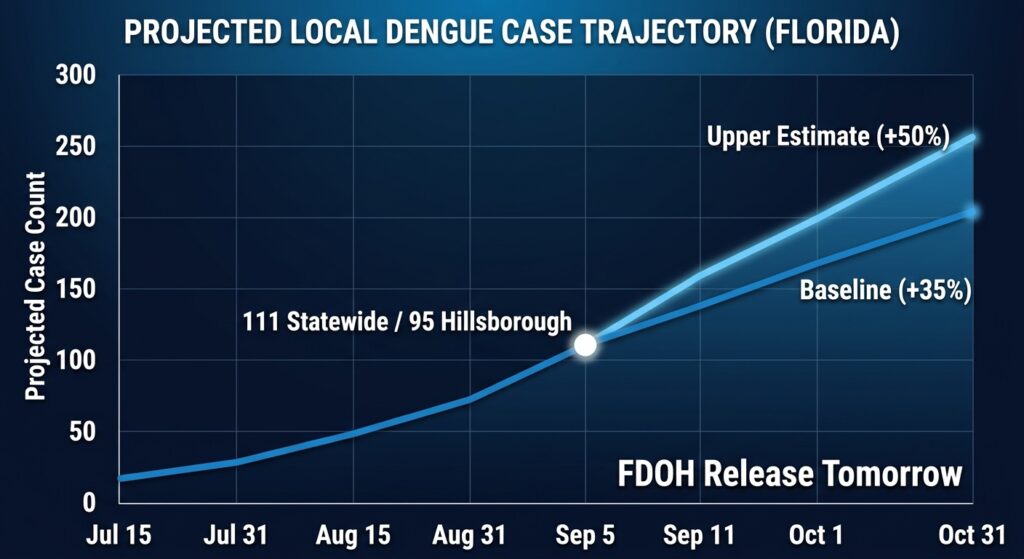
Florida public health officials, municipal mosquito control districts, and infectious disease specialists are bracing for the release of the Florida Department of Health’s (FDOH) upcoming weekly arbovirus surveillance report. The Friday September 17th report will cover the crucial period of September 5th through September 11th. The previous state update confirmed 111 locally acquired dengue cases statewide with an astonishing 95 locally acquired cases concentrated in Hillsborough County alone.

With approximately six weeks remaining in Florida’s primary mosquito season, predictive models indicate the potential for a continued 35% to 50% surge in localized transmission before seasonal autumn temperatures begin to suppress mosquito activity.
Current Case Numbers: Locally Acquired vs. Travel-Associated Transmission
Public health surveillance strictly differentiates between two mechanisms of dengue transmission:
- Locally Acquired Dengue: Infections contracted directly within Florida when a native mosquito bites an infected individual and subsequently transmits the virus to others.
- Travel-Associated Dengue: Infections contracted by individuals traveling internationally to endemic regions (such as the Caribbean or South America) before returning to Florida.
Through the week ending September 5th, Florida recorded 160 travel-associated dengue cases alongside 111 locally acquired cases. Hillsborough County has emerged as the unequivocal epicenter of domestic transmission, accounting for nearly 86% of all locally acquired cases in the state.
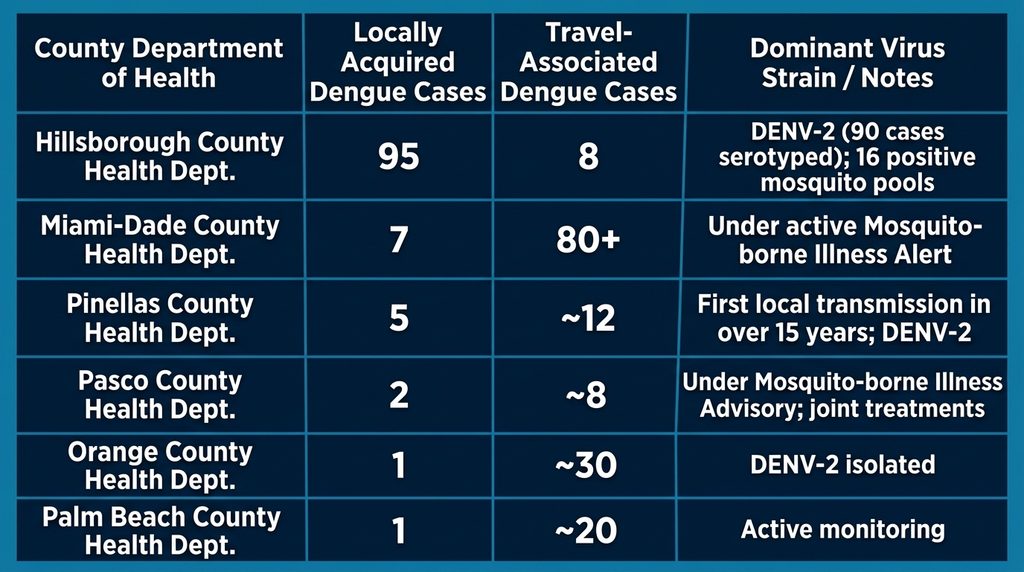
Data Source: Florida Department of Health Arbovirus Surveillance Reports
Speaking on the urgent public health response, Carla Fry, Administrator and Health Officer for the Florida Department of Health in Hillsborough County, emphasized community-wide prevention:
“Wear repellent, especially—that’s really our biggest line of defense against mosquito-borne illness as we work to break the transmission cycle in our neighborhoods.”
Regional Cross-Checking: Vector Trajectory Across Tampa Bay Counties
Local media coverage and health department updates across Hillsborough, Pasco, Pinellas, Sarasota, and Manatee counties reveal an expanding geographic radius of vector risk along major commuter and transportation corridors:
1. Hillsborough to Pasco County Corridor
The cluster in northern Hillsborough County (including neighborhoods like Wellswood, Heights, and East Tampa) prompted immediate collaboration across county lines. The Pasco County Mosquito Control District dispatched specialized aerial and ground crews to assist Hillsborough County Mosquito Management Services.
Because Aedes aegypti mosquitoes have a localized flight range of 100–200 meters, dense residential developments straddling the Hillsborough-Pasco border create seamless transmission corridors. Joint operations deployed low-flying helicopters dropping Bacillus thuringiensis israelensis (Bti) larvicides to eliminate breeding sites in stormwater basins before adult vectors emerged.
2. Pinellas County (Peninsular Spread)
Pinellas County registered 5 locally acquired cases, marking its first non-travel dengue transmission in over 15 years. The localized mosquito control initiated door-to-door inspections and daytime thermal fogging to stop day-biting Aedes mosquitoes from establishing entrenched breeding colonies.
3. Manatee and Sarasota Counties (Southward Surveillance)
While Manatee and Sarasota counties have not reported locally acquired dengue cases in the current surveillance period, both health departments have elevated trap monitoring along the I-75 corridor. With daily commuting between Tampa and Bradenton/Sarasota, health officials are testing trapped vectors to detect potential southward expansion.
Predictive Modeling: Anticipating Tomorrow’s FDOH Release and the 35%–50% Surge
With new official numbers from September 5th through September 11th scheduled for release tomorrow, epidemiological models project a noticeable uptick in localized figures.
If Hillsborough County experiences a predicted 35% to 50% increase in local transmission over the remaining six weeks of mosquito season, local cases could reach between 128 and 142 cases in Hillsborough alone, pushing Florida’s statewide locally acquired total past 150 cases.
Key Biological Factors Driving the Final 6 Weeks:
- Daytime Biting Behavior: Unlike Culex mosquitoes that bite at dusk, Aedes aegypti and Aedes albopictus feed during daylight hours, increasing human-vector contact in residential yards.
- Micro-Breeding Receptacles: A female dengue mosquito can lay eggs in as little water as a plastic bottle cap. Late-summer rain showers continually refill lawn ornaments, gutters, and plant saucers.
- High Asymptomatic Rates: Up to 75% of individuals infected with dengue experience no visible symptoms. These asymptomatic individuals can still infect uninfected mosquitoes, quietly expanding the virus network.
Co-Circulating Mosquito-Borne Threats Across Florida Since June 2026
While dengue dominates recent headlines, Florida’s public health surveillance networks are simultaneously tracking multiple arboviruses detected statewide since June 2026:
- West Nile Virus (WNV): The Florida Department of Health in Duval County (Jacksonville) recently issued a Mosquito-borne Illness Alert after confirming two human cases of locally acquired West Nile Virus. Statewide, seven WNV human cases and multiple positive blood donors have been identified since June across counties including Duval, Alachua, Walton, and Leon.
- Eastern Equine Encephalitis (EEE): A severe virus affecting both humans and horses, EEE has been confirmed in 14 equine cases across Florida since June 2026, including detections in Hillsborough, Orange, Polk, Brevard, Citrus, and Volusia counties.
- St. Louis Encephalitis & Malaria: Active sentinel chicken flock testing and mosquito trap PCR screenings remain underway across all 67 Florida counties to monitor for potential transmission spikes.
Community Action: WellTech Pest Solutions Expands Support and Educational Outreach
In response to the current mosquito-borne health alerts, WellTech Pest Solutions, headquartered near Busch Boulevard in Hillsborough County, is stepping forward to provide direct community support.
Both founding partners of WellTech Pest Solutions are Associate Certified Entomologists (ACE), a professional credential awarded by the Entomological Society of America requiring rigorous testing in insect biology, vector ecology, and integrated pest management techniques.
Recognizing the severity of the situation, WellTech Pest Solutions is offering free professional mosquito inspections to property owners throughout Hillsborough County and all areas that WellTech services including all counties in and around Tampa Bay, Orlando counties, Jacksonville counties and Southwest Florida from now through the end of October, or until the public health crisis subsides.
Jay Wells, President and CEO of WellTech Pest Solutions, outlined the company’s service-first initiative:
“We have been well aware of the situation in Hillsborough County, and want to do what we can to help all of our neighbors. We are providing mosquito inspections at no cost to those in Hillsborough and all of the counties in our service area, whether or not they are our customers… this is purely a service to protect our communities during a genuine health concern.”
–Jay Wells, President & CEO
Expanding Educational Outreach Across Florida
Understanding that mosquito-borne illnesses, from Dengue in Tampa Bay to West Nile in Jacksonville, impact communities statewide, WellTech Pest Solutions is also offering free educational resources and vector prevention guidance across its entire coverage footprint:
- Tampa Bay Region (Hillsborough, Pinellas, Pasco, Manatee, Sarasota)
- Central Florida / Greater Orlando
- Northeast Florida / Jacksonville (Duval County)
- Southwest Florida Corridor
Through virtual consultation materials, community workshops, and printed property-owner checklists, WellTech aims to empower residents across the state to identify micro-habitats and protect their families from daytime and nighttime biting vectors.
Contact WellTech Pest Solutions for any questions or to schedule an inspection.