As a cold front continues across Florida, multifamily property managers face a hidden but significant operational challenge. While residents are reaching for their thermostats, the state’s rodent population, specifically Roof Rats, Norway Rats, and House Mice, is reaching for your buildings’ entry points.
This migration isn’t just a maintenance nuisance; it is a major public health liability. Despite the risks, a recent NPMA/Harris Poll revealed a dangerous “awareness gap,” showing that only 28% of Americans are aware that rodents carry life-threatening diseases.
In high-density living environments, a single infested unit can quickly compromise an entire building. As Dr. Jim Fredericks of the National Pest Management Association (NPMA) recently noted, “Rodent-borne diseases didn’t disappear… the danger is real, especially during the colder months.”
Following the high-profile death of Betsy Arakawa from Hantavirus Pulmonary Syndrome (HPS) last year, and California’s first positive detection of 2026 this February, Florida managers must remain vigilant.
The Hidden Resident: Black Creek Canal Virus
First identified in 1994 in Miami-Dade County, the Black Creek Canal Virus is Florida’s native contribution to the hantavirus family. Unlike the “Sin Nombre” virus found in the Western U.S., which is carried by deer mice, BCCV is uniquely associated with the Hispid Cotton Rat.
Regional Impact and Case History
Statistically, human cases of BCCV remain rare in Florida, but the virus is geographically persistent. Historically, there has been only one confirmed human case of Hantavirus Pulmonary Syndrome (HPS) officially attributed to BCCV in Florida (occurring in a 33-year-old man in Dade County). However, surveillance of the rodent population tells a much more active story.
In the past five years, research and environmental sampling have confirmed that BCCV remains endemic in South Florida. Positive rodent detections and seroprevalence (the presence of antibodies in local rats) have been consistently reported in:
- Miami-Dade County (specifically the Black Creek Canal and Everglades regions)
- Broward County
- Collier County
- Palm Beach County
Despite the low number of human infections, the high mortality rate of HPS—approximately 35-40%—makes any detection a serious matter for property managers.
Other Rodent Diseases
Rodents are vectors for over 35 diseases, several of which are active risks in the Sunshine State:
- Leptospirosis: A bacterial disease spread through water or soil contaminated by rodent urine. In Florida’s humid climate, damp crawl spaces or area rug saturations from leaks can become breeding grounds for this infection, which can lead to kidney damage or meningitis.
- Salmonellosis: As rodents navigate kitchens and pantry areas, they track bacteria across surfaces. This is one of the most common causes of “food poisoning” in apartment complexes with active infestations.
- Rat-Bite Fever (RBF): Contrary to the name, RBF can be contracted through scratches or even by consuming food contaminated by rat droppings. Given the proximity of residents in multifamily housing, the risk of accidental contact increases significantly.
- Lymphocytic Choriomeningitis (LCMV): Primarily carried by the common House Mouse, this viral infection can cause long-term neurological issues and is a particular concern for pregnant residents.
Why the Recent Cold Weather Matters
Florida rodents do not hibernate; they shift their behavior. The recent dip in temperatures has created “pest pressure” against your building’s envelope.
- Explosive Breeding: The stable, climate-controlled environment of an apartment allows rodents to breed without the “natural check” of outdoor weather.
- Structural Damage: To stay warm, rodents gnaw through PVC, wood, and electrical wiring—a leading cause of “unexplained” apartment fires.
- The “High-Rise” Migration: Roof Rats, common in Florida, use overhanging branches to enter through roof vents, establishing colonies in attics long before they are spotted at ground level.
Management Action Plan: Protecting Your Property
Under Florida law, landlords are responsible for “reasonable provisions” for extermination. To protect your residents and property value during this cold snap, follow these NPMA-recommended protocols:
- Seal the Envelope: Rodents can squeeze through openings the size of a dime. Inspect weather stripping, door sweeps, and utility penetrations.
- Proactive HVAC Checks: Ensure that rodent nesting materials aren’t clogging vents or being shredded into the air ducts.
- Safe Cleanup is Mandatory: Never allow staff to sweep or vacuum rodent droppings. This releases deadly hantavirus particles into the air. Always soak the area with a bleach-based disinfectant first, then wipe or mop.
- Sanitation Reinforcement: Increase trash valet frequency and ensure dumpster lids are heavy and functional.
- Airtight Storage: Encourage residents to store food in airtight containers and remove clutter, which provides the nesting material rodents crave during winter.
- Educate Residents: Encourage tenants to report “scratching” sounds in walls immediately. Early detection is the difference between a one-unit treatment and a building-wide crisis.
Multi-family Experts
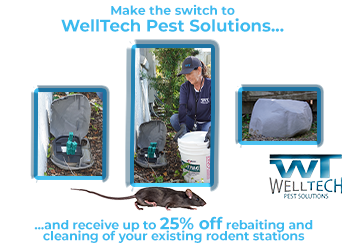
With nearly 40 years of specialized experience, WellTech provides a network of integrated solutions designed exclusively for the unique demands of Florida’s multifamily properties. Unlike standard residential services, WellTech’s approach centers on high-capacity protection through strategic rodent station baiting and precision trapping programs that scale to meet the needs of large apartment communities.
Recognizing that removal is only half the battle, WellTech’s experts specialize in comprehensive structural exclusions. By identifying and sealing every vulnerability, from roofline gaps to utility penetrations, we create a barrier against future migrations. This proactive, preventative framework ensures resident safety and long-term property value.
If you would like additional information on how your property can get a bid on rodent protection, contact WellTech Pest Solutions by calling us at 727.734.7726 or emailing service@welltechpest.com